
Magnificent Glowering
Katie Roiphe on Charlie Rose

I am in the process of becoming Henry Begler-pilled. Becoming, because while I have taken a sniff at some of his imposing essays on great literary figures of the twentieth century, I have not given them the undistracted time they deserve, amidst the many other phantasmal fists pulling at my garments for attention (bills, health issues, cleaning one’s apartment, getting to church in 17 degree weather, etc.). Sometimes I scroll past something on Notes and think “I should really read that,” then scroll past it again three days later and think, “Damnit, I should really read that.” Well, I finally did read some of it. And I was delighted.
The lead image for his post “Scintillating Scribbling” is a still of the writer James Wolcott against that tantalizing, telltale black background that characterizes a Charlie Rose interview. Begler’s apparent affection for mainlining old episodes of Charlie Rose is near and dear to my heart. The stark black background is not the only feature that transports one, madeleine-like, to a very specific intellectual mood. It’s also the theme music, that vaguely Muzak-y, late 80’s/early 90’s sound, inoffensive yet snappy, that one YouTube commenter described thusly: “Midtown East, 9:30 pm, leaving a bar, shoulder pads lookin’ goooooooood.”
Henry’s James Wolcott piece was full of sentences I immediately found myself living for. He narrates how his subject disdains Susan Sontag, how he refers to “her practice of giving endorsements as ‘swinging her incense ball,’ and describes her acolytes as having a ‘pinched anality.’” He illustrates 2012, in intellectual memory, as a year when “the old sequoias were falling and no green shoots had yet emerged to take their place.”
His piece on James Wolcott was preceded by a long rumination on Sontag herself, which was preceded in its turn by an equally lengthy meditation on Janet Malcolm. An earlier exploration of Christopher Hitchens’ legacy, “Get It Right or Die,” contains the following quotation from the critic Stefan Collini, which describes Hitch’s journalism but could also describe much of the better cultural criticism on Substack today:
It self-consciously repudiates the credentials of academic scholarship; it disparages the narrow technical expertise of the policy wonk; it cannot rest on the standing of achievement as a politician or novelist. In other words, it has nothing to declare but its talent.
The success of such writing depends on its “forceful, readable style,” Collini claims. It has a die-hard quality.
I am reminded of an anecdote from a man I dated who had worked at Esquire magazine. A buddy of his, in the emo days of yore, had been assigned to cover My Chemical Romance on tour. One day, while sitting with swoosh-haired heartthrob Gerard Way on the MCR bus, his buddy had gotten down to business and asked: “Look, man. Are you really serious about this emo stuff? Like, do you really mean it? Are you invested in this? Do you really believe in the things you sing about? Or is this just an act?”
Allegedly, Way stared back at him, unblinking, the way a wolf stares at its prey in the final stage of stalking. It was as if someone had asked him to sacrifice his firstborn, or condemn his most cherished creed, or kill his own dog.
“Get out of the bus,” he breathed.
That, my friends, is how some of us feel about cultural criticism. It’s the first thing we think about when we wake up in the morning. It’s the thing we Google in the middle of the night. It’s the 13th time we’ve watched a Charlie Rose episode, that we’ve already basically memorized, because one of our heroes is in it. It’s ride or die.
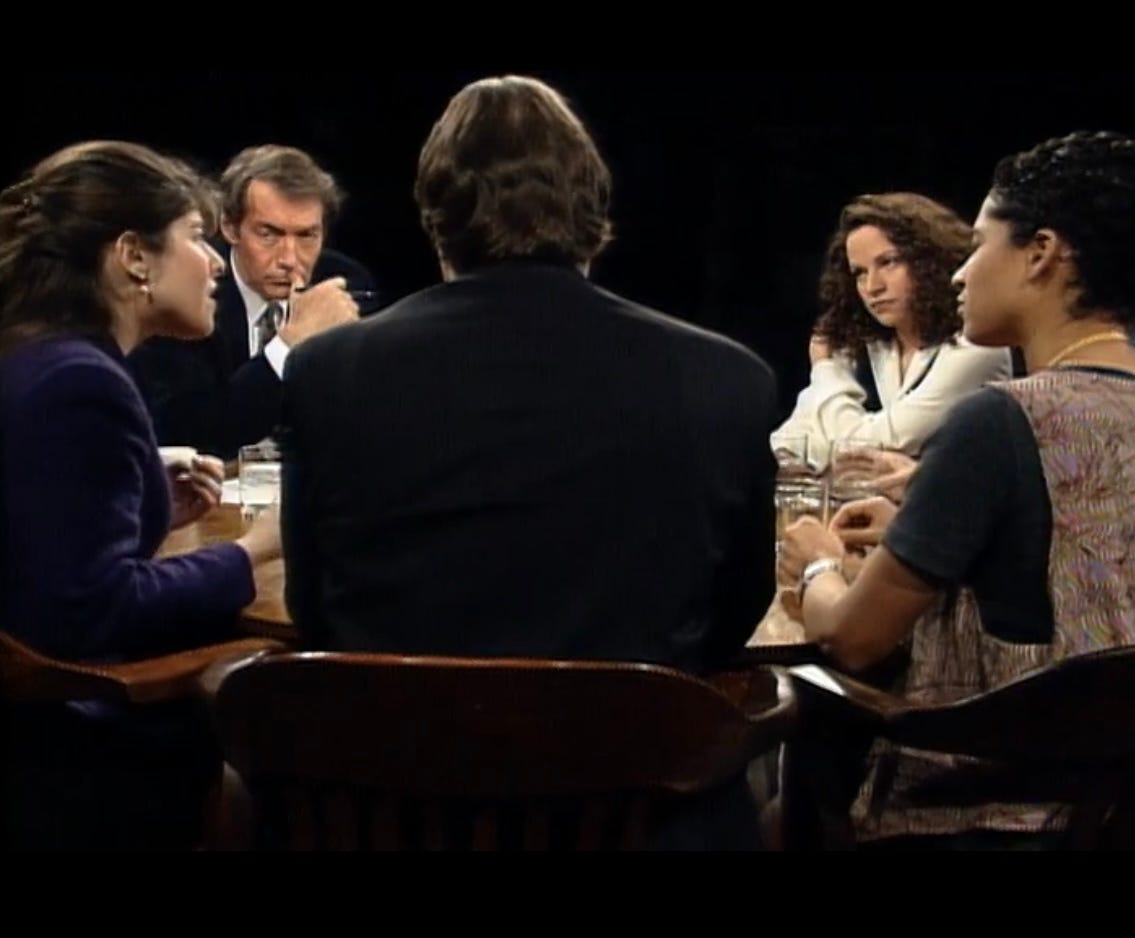
My favorite Charlie Rose episode from the past is undoubtedly a discussion on sexual politics from January 3rd, 1994. Rose panels an at-times-very-tense conversation between Katie Roiphe, Naomi Wolf, Christopher Hitchens, Tad Friend, and Rebecca Walker. Walker is an activist and the founder of women’s organization Third Wave. Friend is an editor for Esquire. Hitchens is, well, Hitchens. Naomi Wolf is a strident feminist voice from the 90’s turned floridly anti-establishment current-day commentator, the author of such influential books as The Beauty Myth. And Roiphe, one of my perennial heroines, makes her debut here as a 24-year-old writer and the recent author of a book called The Morning After: Sex, Fear, and Feminism on Campus.
The book grew out of an earlier Times op-ed that established Roiphe as an incendiary voice capable of deeply irritating certain segments of the educated readerati. This was perhaps not her intention, as her case seems eminently reasonable to me, but in that moment of journalistic lore a firebrand was born. The Rose episode aired six months after the infamous Lorena Bobbitt event of the severed penis (which Rose refers to with gentlemanly understatement as “the unkindest cut of all”). The host characterizes that moment as having “revealed the rage that was lurking beneath the surface of male and female relations,” and introduces the discussion as an attempt to address the “conflict on the sexual battlefield.” Wolf and Walker assert that a rape crisis is ensuing on American campuses; Roiphe cautions that the truth is perhaps more complex, and that new guidelines for consensual sexual encounters (such as the infamous Antioch rules) are reminiscent of Victorian guides to conduct. Hitchens dithers charmingly on the “capricious” quality of the male organ and chides such newfangled norms as having a “may I remove your bustier?” quality.
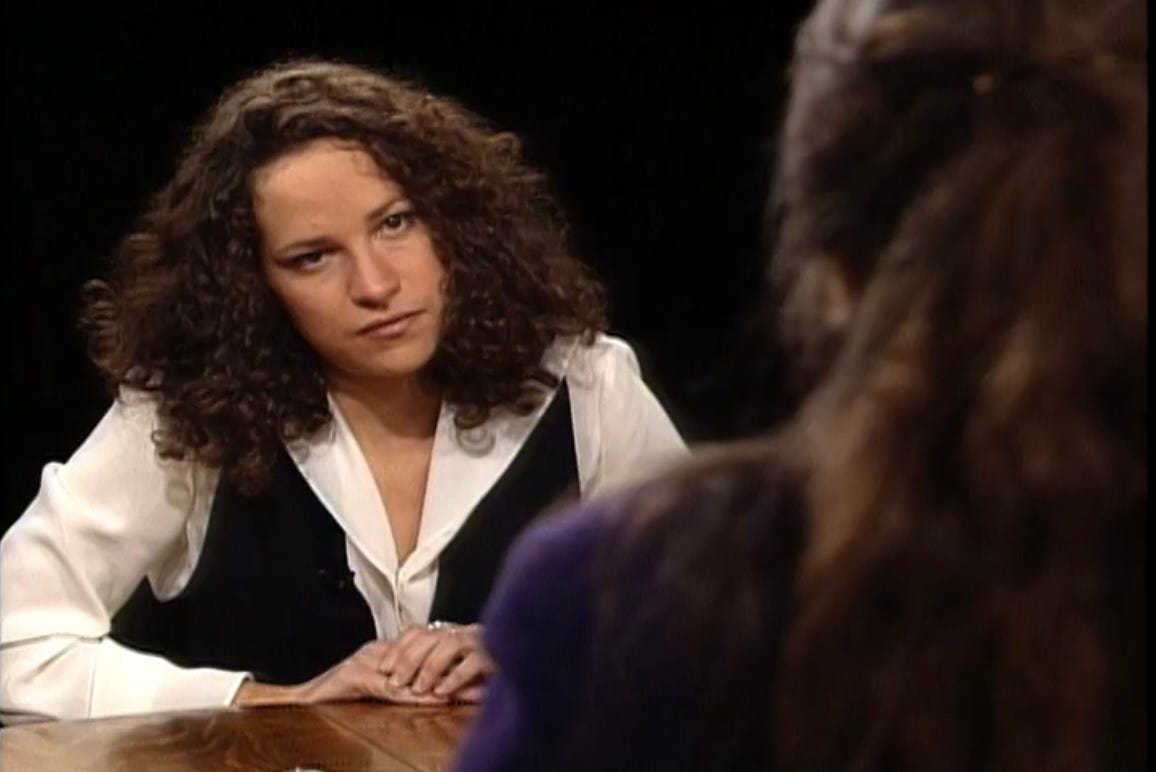
Poor Katie can barely get a word in, what with all the rapid-fire from an insistent Naomi, and Tad Friend is more than a tad mute. Although she is almost constantly interrupted, as though her interlocuters fear a terrible social consequence to her ideas being heard, she is gracious and even generously expresses relief when Wolf complicates her own position. But in the midst of that civility, another thing happens. A thing that I love: magnificent glowering. One could also call it “resting polemicist face.”

Roiphe’s manner of gazing at Naomi while she is speaking is exactly how I pictured Gerard Way’s expression when he told the reporter to “get out of the bus.” It represents a deep investment — a glowing, simmering inner fire that lies in wait beneath a polished exterior. It is thrilling.
It would be impossible to express my full admiration for Roiphe in this short essay — the way her brilliant 2012 book, In Praise of Messy Lives, exonerated my own past; the specific place she occupies in centrist liberal, not-quite-conservative media feeling similar to my own groove; my recognition of a deep, explosive power in her sensibility that felt similar to something in my soul.
We all need heroes, and Roiphe certainly has been one of mine. Years ago, on long train rides or curled up with my laptop in bed, I started searching for interviews in which she might have given advice to young writers. Or even to women of a certain kind, and I count myself among them: women who are free.
I found this extraordinary, small memento on the occasion of Christopher Hitchens’ death that addressed the 1994 Charlie Rose episode. She writes:
I first met Christopher on the set of the Charlie Rose show at a low point early in my career of provocation. The attacks were beginning to get to me, and I was thinking: Is it really worth having every nice, right-thinking liberal person in the country hate you? In any event, it felt that morning on the black set, with Naomi Wolf and other clucking third-wave feminists, like we were stuck for all time in Sartre’s No Exit. When the cameras started rolling I found myself waiting for a deus ex machina to save me, and that elegant, rumpled deus ex machina turned out to be Christopher, who in his wry, dazzling way wiped the floor with the clucking feminists.
Afterward, Christopher hailed a cab and took me for cocktails at the Pierre hotel, one of those old-fashioned Fifth Avenue hotels with a heated awning. This felt exotic to me, partly because I was 24, and partly because it was 10:30 in the morning. He was a thrilling talker. We sat in the empty grandeur, and three hours and five drinks later Christopher had somehow charmed me back into the calling. His point, which he was the living embodiment of, was that provocation was fun. In any event, it was fun with him or around him, or when he did it, and the world can be a little bit consoled that the fun and irreverent, erudite, near prophetic charisma is still there in the sentences.
Now, imagine being able to write two paragraphs that describe a scene with such panache. Hitchens as an “elegant, rumpled deus ex machina” (perfect!). Sitting in the “empty grandeur” with him, pounding cocktails at not-even-eleven-o’clock-A.M. God, how I wish I had someone to do that for me! To tell me not to worry about the chuds in the comment section, rending their garments and gnashing their teeth about something I said, while administering the next bourbon on ice and all but shoving it down my gullet.
I also found this Conor Friedersdorf piece in The Atlantic from prehistoric 2009. Friedersdorf studied with Professor Roiphe at NYU, and writes about a key piece of wisdom she provided on the art of opinion.
Katie believed that even the most fair-minded writer must sometimes twist the rhetorical knife so that the distracted average reader, skimming along in multitasking mode, is jolted into actually engaging the argument at hand.
Now, does this mean we write things we don’t believe? Not necessarily. To me, it means that when you write, you let something else take over. A less-reasonable side of yourself. A side of yourself that has nothing to do with how politely you may treat someone on the street.
For people like Begler and myself, who are trying to figure out how to write on our own and by reading each other, the Charlie Rose archive is a portal to infinite instruction. To echo Katie’s piece, we can be a little bit consoled that the elegantly civil, gloriously sullen, magnificent glowering is still there in the episodes.
Some Notes on the Second Amendment
“A well regulated Militia, being necessary to the security of a free State, the right of the people to keep and bear Arms, shall not be infringed.”

I felt myself transformed into the “mind blown” emoji over the past week and a half while witnessing various people in the Trump administration (Kristi Noem, Scott Bessent, Kash Patel) and none other than the president himself betray one of the most important parts of the Bill of Rights. I thought I was losing my mind as I watched Noem characterize Alex Pretti (an American citizen legally carrying a gun under Minnesota law) as a domestic terrorist, Bessent smugly condemn the idea of bringing a gun to a protest (again, perfectly legal in this case), and FBI Director Patel falsely assert in nasal tones that “You cannot bring a firearm loaded with multiple magazines to any sort of protest that you want. It’s that simple. You don’t have that right to break the law and incite violence.”
On the same day that Pretti was killed, the Minnesota Gun Owners Caucus wrote: “Every peaceable Minnesotan has the right to keep and bear arms — including while attending protests, acting as observers, or exercising their First Amendment rights. These rights do not disappear when someone is lawfully armed, and they must be respected and protected at all times.”

It got crazier when later in the week, Donald Trump was filmed saying “you can’t have guns. You can’t walk in with guns. You just can’t.” What?
I literally thought I was tripping balls when I heard that. I know nothing should surprise me anymore. And I have long privately heaved an inner sigh when observing others, even others I greatly respect, go into paroxysms over every single thing Trump says. He says a lot of crazy shit. But this went way too far, even for me.
It was the second blow, after the torment inflicted on SNAP recipients during the last government shutdown, that has really soured me on the Trump administration. I am furious about this.
This is just wrong. This is wrong on so many levels. We are Americans. We can have guns. In many states, we can have them at protests. The right to bear arms and to protect oneself against government tyranny is fundamental to this country and especially to the American conservative sensibility. Guns are about self-defense and self-reliance. This administration is turning conservatism, like artificial cheese, into a conservatism-flavored product. Come on people. Are we patriots or not? Are you really going to give up the Second Amendment for this?
2A, with its emphasis on self-defense, is connected to the dignity of conscience which is protected by the First Amendment. This is sacrosanct. Is it the hardest thing in the world, when it doesn’t favor your side? Yes. It can be. But you either have principles or you don’t. You either believe in what America really is — a country with a Constitution and a Bill of Rights — or you don’t.
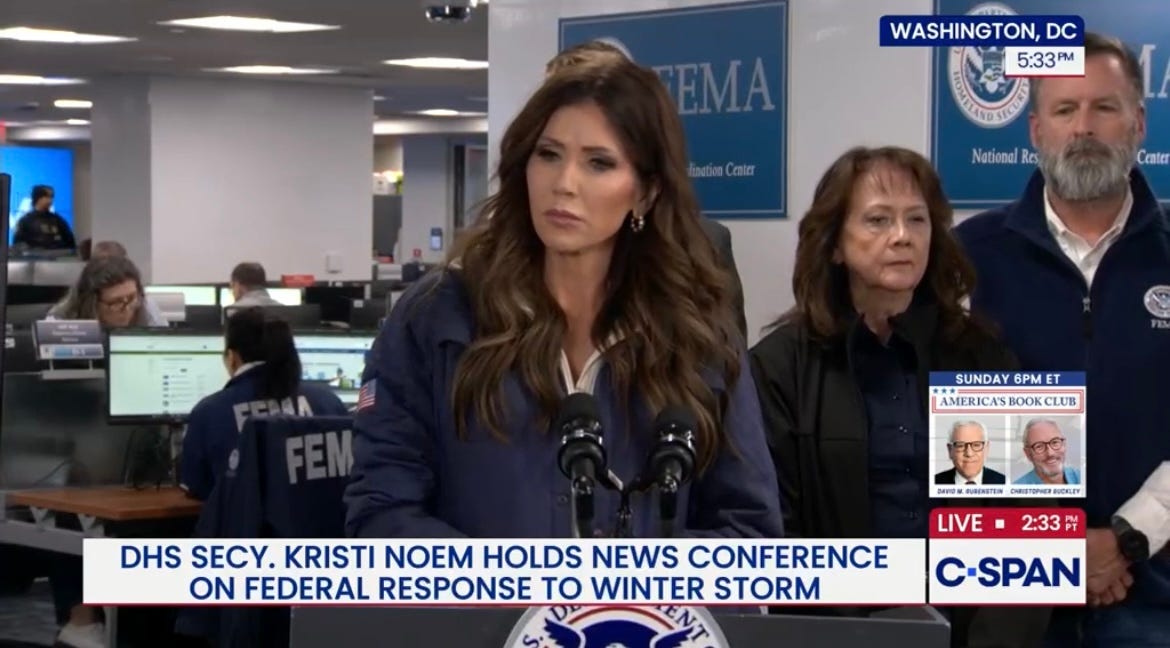
I’m also just tired of the garish drag of the Trump administration. Kristi Noem couldn’t be bothered to properly uphold the Second Amendment, but by God, those hair extensions are on POINT, honey!
Girl, bye.